
Most people assume a bigger Google Ads budget means better results. It’s a fair calculation, but it’s one of the most common misconceptions in paid advertising.
Small businesses often outperform larger competitors simply by spending more carefully. In many cases, it’s what keeps a small ad budget strategy sharp and accountable. Every dollar has to work harder, and that pressure tends to produce smarter decisions.
This article covers why spending less can sometimes get you more. And what that means for how you run your ads going forward.
Small Budget, Smart Strategy: What’s Really Going On
The best part about running a small ad budget is that it cuts out all the extra noise. Large budgets can mask poor targeting, while leaner ad spend demands that every dollar earns its place across your ads.
That discipline shows up most clearly when you look at how big spenders operate and why their size can work against them.
Why Big Spenders Don’t Always Win

Here’s something most people don’t expect: a sizable Google Ads budget doesn’t automatically mean better returns. According to a study, the average account wastes $1,127.54 per month, which is over a third of its budget on clicks that never convert.
Wasted spend on broad audiences is one of the most common issues in larger Google Ads accounts. When nobody is watching the numbers closely, a significant portion of the budget quietly disappears on clicks that never convert.
Meanwhile, a tighter spend forces you to go after the right target audience from day one. That means prioritising high-intent keywords over more spend on terms that bring in the wrong people.
Now that we’ve covered why more spending doesn’t guarantee results, let’s look at what a smaller budget pushes you to do better.
The Focus Effect: Fewer Dollars, Fewer Distractions
Focusing on one campaign at a time naturally brings your cost per click down over time. So, when the budget is limited, you stop bidding on different keywords that don’t serve your business goals.
Less budget also means fewer variables to sort through. It becomes far easier to spot what’s actually driving conversions and what’s just losing money on autopilot.
How a Small Daily Budget Forces Better Decisions
A capped daily budget is one of the most underrated tools in Google Ads because it keeps every decision intentional. When there’s a hard limit on what you can spend, you stop making lazy choices inside your Google Ads account.
Here’s what a small daily budget actually pushes you to do:
- Audit Your Ads Constantly: A limited budget means you review every keyword, ad group, and bid far more regularly. Search term reports become essential because wasted spend is simply not an option.
- Let Machine Learning Work: Google’s algorithm responds well to consistent, modest daily budgets over time. Feeding it steady data leads to better budget allocation across your campaigns.
- Cut Dead Weight Fast: Smaller accounts catch underperforming ads quickly because there’s less noise in the data. Adding negative keywords becomes a regular habit rather than an afterthought.
- Stay Data Driven: Every decision gets tied back to actual numbers rather than gut feeling. That kind of discipline separates a well-run campaign from one that just burns through budget without direction.
A small daily budget won’t hold your results back. More often than not, it’s the thing that keeps your paid advertising strategy honest and on track.
What Small Budgets Do Well: Landing Pages, Conversion Rate, and Local Targeting
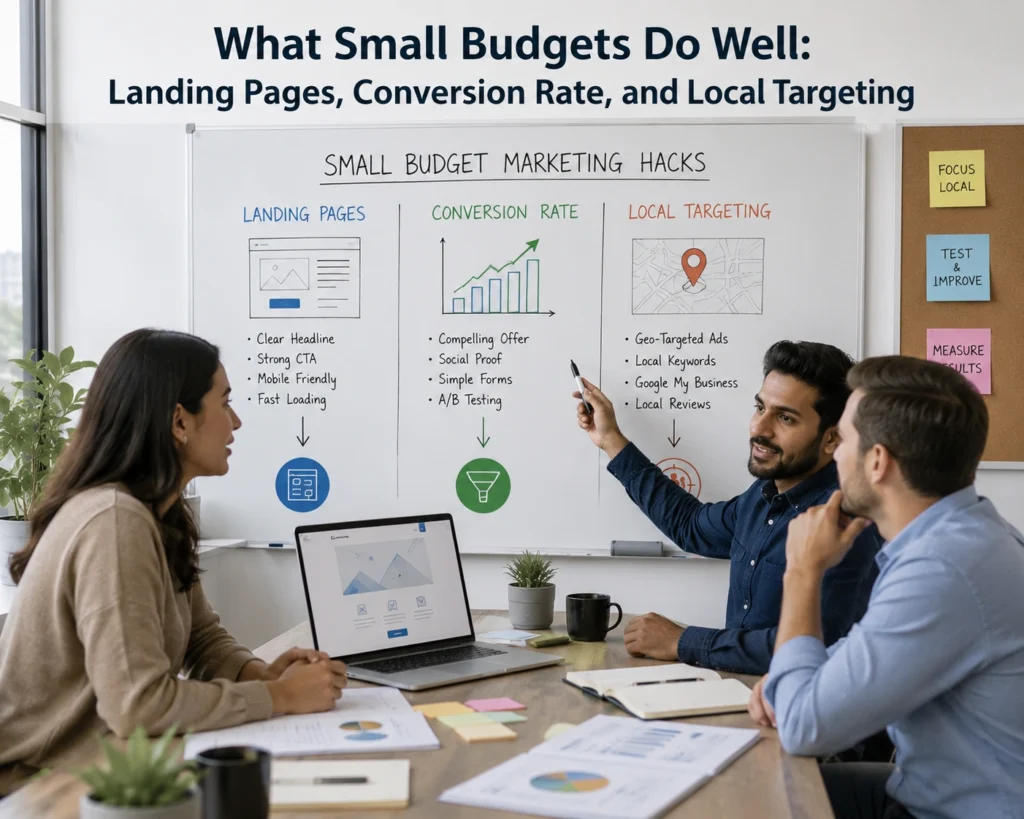
With paid ads, there’s very little room for error when your budget is tight. That pressure actually works in your favour because it pushes you toward a stronger conversion rate and more deliberate targeting from the start.
Landing Pages That Do the Heavy Lifting
What if your landing page was doing more damage than your ad targeting? The average Google Ads CVR across industries has risen to 8.18%, which shows how much optimised landing pages and tighter targeting improve campaign efficiency.
A well-built landing page can lift your conversion rate without touching your ad spend at all. So before scaling anything, most experienced managers look at the page itself first. Load speed, clear messaging, and a single call to action are the basics that move the needle.
When you match your landing page copy to your ad, Google Analytics starts showing you something interesting. Website visitors stick around longer, bounce rates drop, and form submission numbers begin to climb.
So far, we’ve covered what happens on the page. Now, let’s look at how local targeting gives small budgets a genuine edge in the market.
Local Businesses and the Google Display Network Advantage
Local businesses can use the Google Display Network to put their ads in front of potential customers in a specific suburb or postcode. That kind of reach used to cost a lot more through traditional media.
The result is that every dollar goes toward people who can become customers, not just clicks from the wrong postcode.
Measuring Success on a Monthly Budget: What to Watch

Measuring success on a small monthly budget means you need to track the metrics tied directly to your business goals. We’ll explain what those metrics are in detail below.
The Metrics That Actually Reflect Your Business Goals
Once you know which metrics to ignore, it becomes a lot easier to act on the ones that count.
| Metric | What It Measures | Why It Matters |
| Return on Ad Spend | Revenue generated per dollar spent on ads | Shows if your budget is producing real returns |
| Cost Per Conversion | What each lead or sale costs you | Tracks efficiency across your Google Ads account |
| Click-Through Rate | How often people click after seeing your ad | Reflects how well your ad creative is working |
| Conversion Data | Actions taken after clicking your ad | Ties paid media performance to business goals |
| Efficiency Metrics | Overall campaign output vs spend | Helps with better budget allocation each month |
Business goals should always sit at the centre of this process. If your goal is filling a pipeline, winning new customers, or closing direct sales, every number you track should tie back to a tangible outcome.
Small Budget, Big Potential: Here’s Your Next Step
A solid small ad budget strategy doesn’t need a massive monthly budget to deliver tangible benefits. Small businesses across Australia are already getting strong returns from paid media without overspending on ad platforms like Meta Ads or Google Ads.
Here’s what a well-managed small budget campaign typically covers:
- Targeted ads built around high-intent keywords
- Regular audits to cut wasted spend early
- Strategic use of Google Display Network for local reach
- Clear business goals tied to every dollar spent
If you’re ready to get more from your Google Ads budget without the guesswork, KC Freedom is here to help. We work with small businesses across Melbourne, Sydney, and Brisbane to build campaigns that perform well. Visit kcfreedom.net to get started.