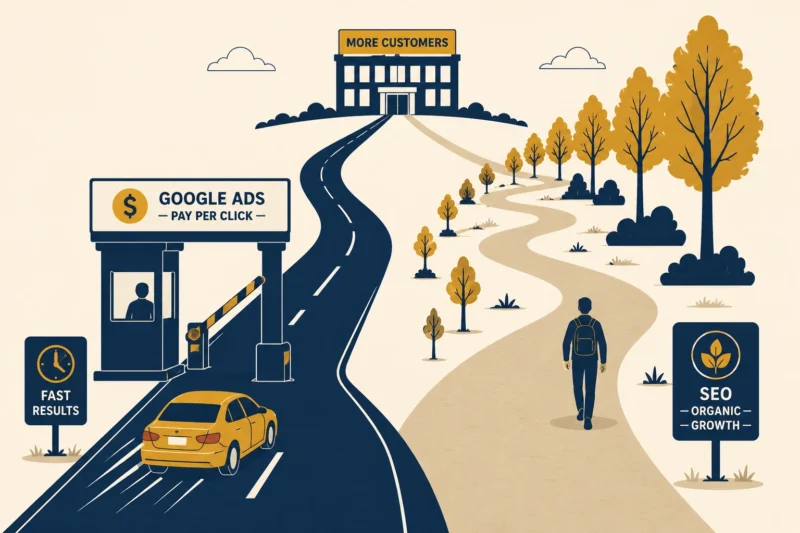
Google Ads delivers traffic almost immediately, while SEO takes time but builds momentum that lasts. If you’re deciding between the two, the real answer depends on how quickly you need results and how long you want them to last.
But the problem is that most businesses pick one without fully understanding the trade-offs. Paid ads can generate leads fast, but the moment you stop spending, the traffic disappears. With SEO, results take longer to show up. However, once it does, you are not paying for every single click.
This article breaks down both channels across speed, cost, and user behaviour, so you can choose the approach that fits your current stage of growth. And if Google ads versus SEO is a debate you’ve been sitting on for a while, you’ll have a clear answer by the end.
Google Ads vs SEO: The Core Differences
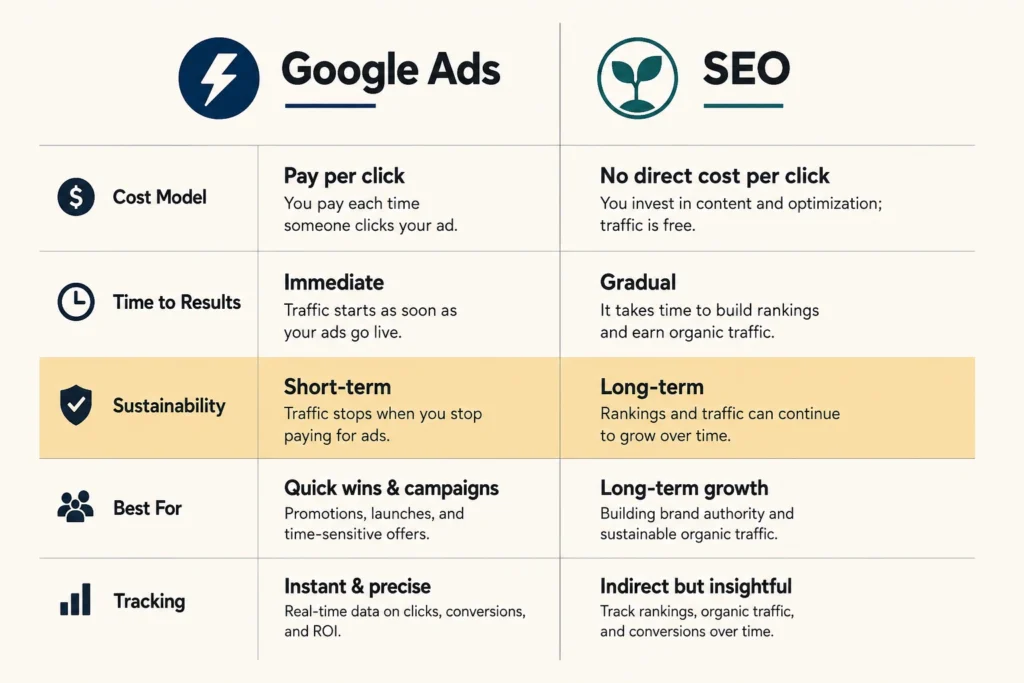
As mentioned above, Google Ads delivers paid, immediate visibility in search results, while SEO builds unpaid, long-term traffic over time. Here’s how the two compare:
| Factor | Google Ads | SEO |
| Cost Model | Paid ads, cost per click | Free organic search results |
| Time to Results | Hours to days | 3 to 6 months minimum |
| Sustainability | Stops when spend stops | Builds and compounds over time |
| Best For | Fast leads, new businesses | Long-term growth, brand authority |
| Tracking | Google Ads dashboard | Google Search Console |
Unlike traditional advertising, both channels give you measurable data on what’s working. The main difference lies in how long results last and what it costs to sustain them. That difference is what drives the overall commitment each channel requires.
How Fast Can Each Channel Deliver Results?
Google Ads can have your business showing up in search results within 24 hours. SEO, on the other hand, takes months before you see any real movement. Let’s take a look at how each one actually plays out.
Google Ads Delivers Fast Results
When you run a paid ad campaign, your business appears at the top of search results pages almost instantly. It’s because Google Ads works on an auction system. You bid on relevant keywords, set your budget, and your ads start showing up when people search for those terms. Unlike SEO, there’s no need to build up site authority first. You pay for placement, and Google puts you in front of potential customers right away.
In fact, we’ve seen new businesses in Sydney get their first enquiries within days of launching search ads (something that would’ve taken months through SEO alone).
SEO Takes Time but Pays Off
Most SEO strategies take 3 to 6 months before organic traffic starts to move in a meaningful way. Because search engines need time to crawl, index, and evaluate your site before rankings begin to improve.
But once that momentum builds, the impact compounds. Each piece of content, backlink, and technical improvement strengthens your site’s authority, which allows it to attract traffic consistently without ongoing spend.
Quick Fact: According to BrightEdge, organic search drives 53% of all trackable website traffic on average and is the largest single source of traffic across most industries.
Cost vs Long-Term ROI: Google Ads vs SEO
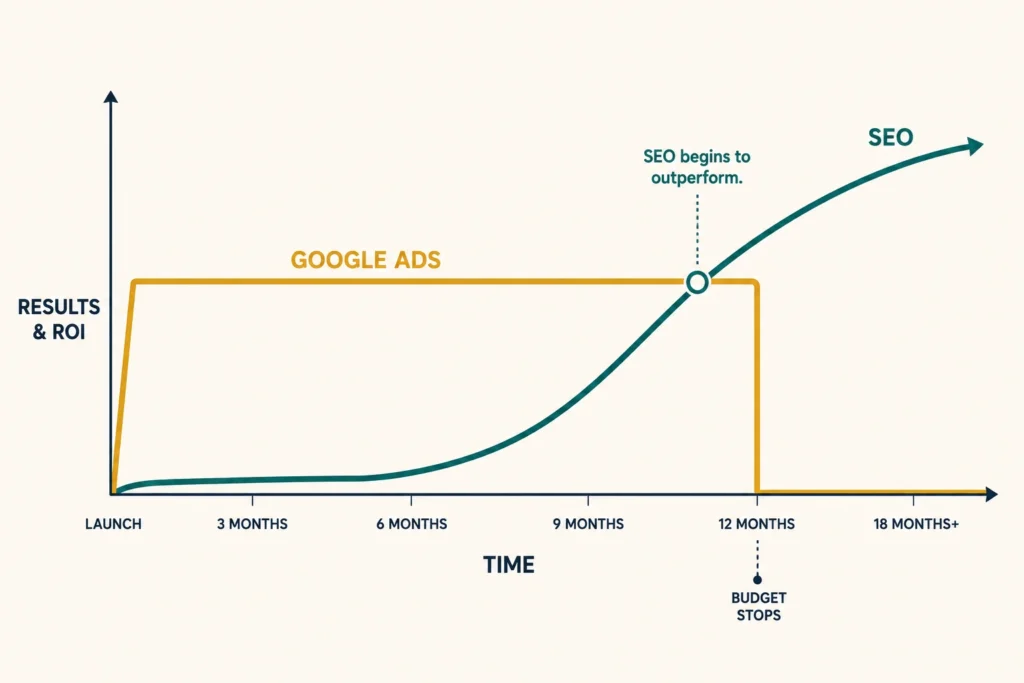
With Google Ads, every click costs money. The more competitive your industry, the higher that cost gets. A plumber in Brisbane running PPC campaigns during peak season, for example, may pay between $10 and $30 per click, depending on the keywords targeted. And if those clicks aren’t converting, the ad spend builds quickly without much revenue to show for it
SEO also requires upfront investment in content, technical optimisation, and sometimes external support. The difference is what happens over time. Once your site starts ranking, the traffic coming through organic search doesn’t carry a cost per click. Over time, the long-term ROI begins to outweigh paid acquisition.
Google Ads plays a strategic role beyond immediate traffic, too. Campaign data, especially keyword and conversion insights, can directly inform your SEO strategy and future content decisions.
Bottom Line: Google Ads gives you control and consistency from day one. SEO is less predictable early on, but becomes far more cost-efficient once it gains traction.
User Trust: Organic SEO vs Paid Search Results
Many users instinctively skip paid ads and scroll straight to the organic results. Some even use ad blockers, which means certain paid search placements never get seen at all. That behaviour reflects how trust is built in search engines, and it directly influences the kind of traffic each channel brings in.
When you look at how users actually interact with search engine results pages, the difference becomes much clearer:
- Building Brand Recognition: When your business shows up consistently in organic results, people start to associate your name with the topic they’re searching for. That kind of brand visibility takes time to build, but it carries real weight in the customer journey.
- Capturing Ready-to-Act Users: Users who click paid search ads are often further along in their decision. They’re ready to act, which makes paid ads highly effective for capturing demand at the bottom of the funnel.
- Varying Performance by Search Intent: For informational search queries, users tend to trust organic results more. But for transactional searches like “emergency plumber Melbourne,” paid ads often get the click because the intent is immediate.
- Covering the Full Customer Journey: Organic marketing builds awareness and credibility gradually, while paid search captures intent at the moment it peaks. Together, they cover more of the customer journey than either channel could alone.
If lead quality is your priority, organic SEO attract more considered visitors over time. Paid search can still drive high-value leads, but the intent is more immediate. That’s why it’s better suited to capturing demand rather than building trust.
When to Use Google Ads, SEO, or Both
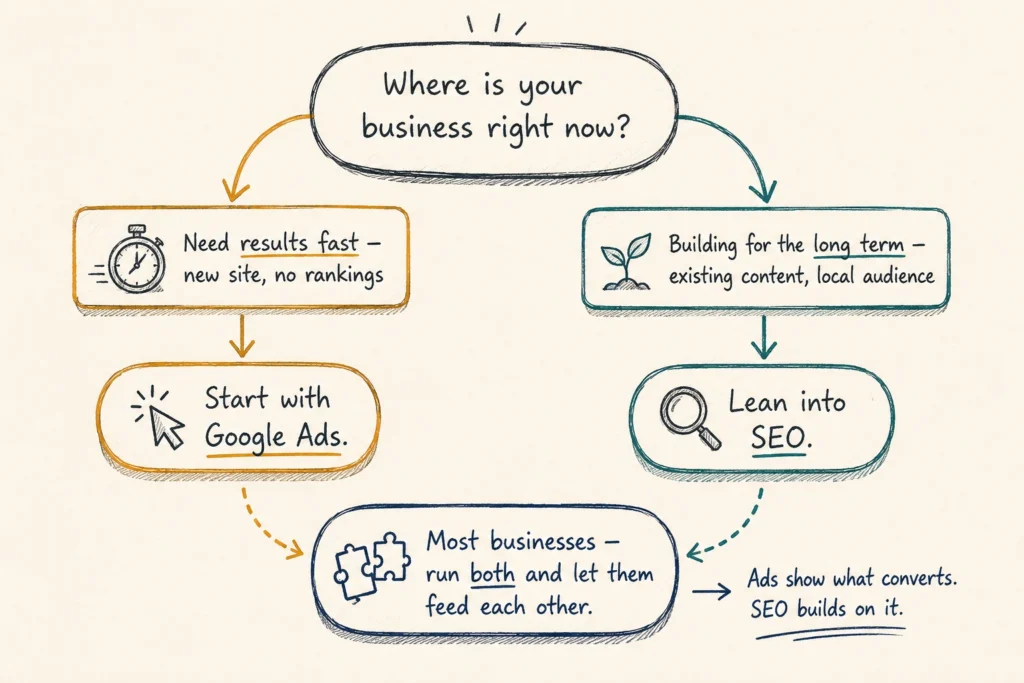
The honest answer is that most businesses benefit from running both, just not always at the same time or in the same way. The right starting point depends on where your business is right now.
The table below breaks down which strategy fits different business goals and growth stages.
| Use Google Ads if you: | Lean into SEO if you: |
| Need leads quickly and can’t wait months for organic results | Are focused on long-term business growth and building brand authority |
| Are launching a new website or service with no existing search presence | Have an existing content marketing strategy you want to build on |
| Want to test messaging and offers before committing to a full SEO campaign | Want to reduce reliance on paid ads over time |
| Operate in a competitive market where ranking organically takes considerable time | Are targeting a specific local audience through local SEO and a Google Business Profile |
From working with businesses across Melbourne, Sydney, and Brisbane, we’ve seen most strategies work best when they don’t rely on just one channel for long. When you’re integrating SEO alongside your Google Ads campaigns, the two channels start feeding each other.
Paid ads show which keywords and landing pages convert best, and that data strengthens your organic strategy. Together, they create a more balanced approach that delivers results now while gradually reducing reliance on paid spend over time.
Ready to Stop Guessing and Start Growing?
Google Ads and SEO are two different tools that work better together than apart. The right mix depends on where your business is right now and what you’re trying to achieve in the next six to twelve months.
If you’re ready to get more out of your Google Ads spend, we can help. At KC Freedom, we work with businesses across Melbourne, Sydney, and Brisbane to build paid ad campaigns that convert.
Get in touch today, and let’s put together an approach that fits your business.